
Swedish Folktales: Gotland
From "Svenska folksägner" by Herman Hofberg.
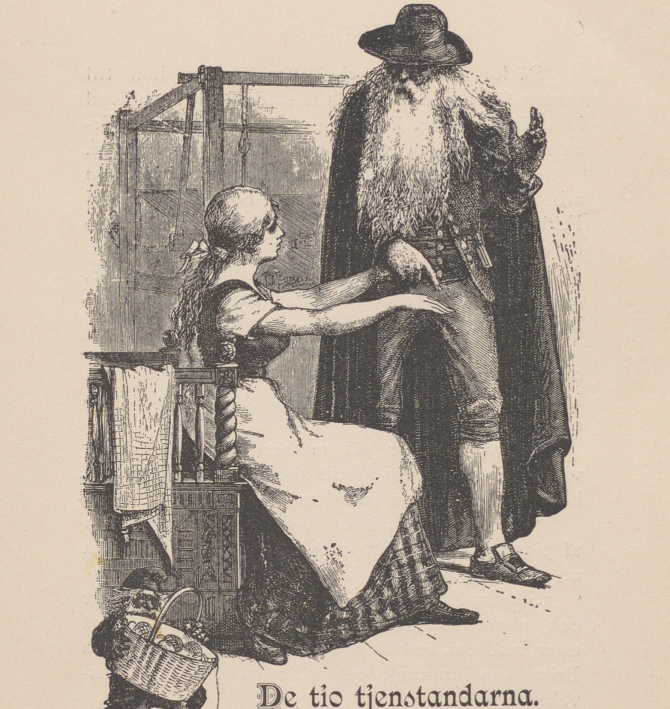
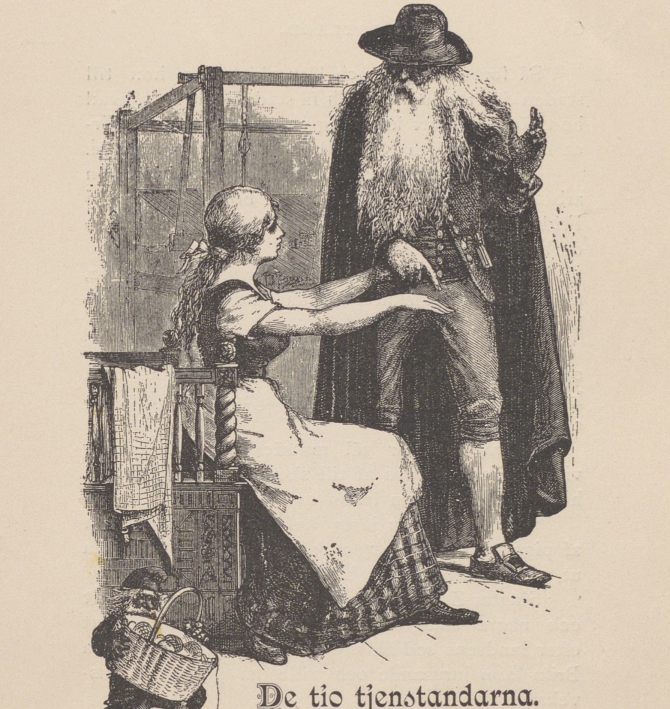
The Ten Servant-Spirits
In Gullbjers, long ago, there was a farmer and his wife who had a daughter, Elsa. As she was an only child she got spoiled rotten, and for her parents her littlest wish was their command.
When it was time for her to get herself an education, they sent her to the city to learn sewing and learn how to be “urbane.” But all she wound up learning was to wear expensive clothes and to despise housework and manual labor even more than she did before.
One day when she was twenty years old a hardworking, competent, and honorable man, Gunnar of Fridarve, proposed to her, and in just a few months, they were made man and wife. At first, Elsa was overjoyed, but she soon got fed up with all the headaches that managing a household entails.
Early one morning right before Christmas things were bustling at Gunnar’s farm. Elsa had hardly gotten out of bed when Olle the farmhand stepped in and said, “Mistress has our lunchbags ready, right? Because we’ve got to leave for the woods now if we’re to come back with the firewood before the sun sets.”
“Mistress! The bread dough has risen!” cried one of the maids through the door. “It would be awfully nice if mistress could come out now.”
Zakris, the butcher, who had already stuck a large boar and several piglets, had just stepped in to get the customary “sticking tipple,” when old Brita came rushing in and asked for yarn to wick candles with.
At last Gunnar himself came in, a bit testy because the farm hands still hadn’t left for the woods. “My blessed mother,” he said in a kindly but serious tone, “always put things in order the night before when the farmfolk had early morning chores, and I’ve asked you to do the same, dear Elsa! – And another thing, don’t forget the weaving. There’s only a few yards left, and it just won’t do for the loom to stand idle in the guesthouse over the weekend.”
Now Elsa had run out of patience. She rushed out of the kitchen and into the guesthouse, slammed the door and locked it and threw herself down on a sofa, sobbing. “No!” she cried, “I just can’t live like this, slaving away all day. Who could’ve believed that Gunnar only wanted me for his wife so that I could work like a dog on his farm? Ugh, I’m so miserable! Isn’t there anybody who can help me out of this drudgery?!”
“I can!” said a serious voice, and in front of her stood an old man with a broad-brimmed hat over his snow white hair. “Don’t be frightened!” he said. “I came to offer you the help you’ve just wished for…My name is Hobersgubben. I’ve known your family back to the tenth and eleventh generations. Indeed, it was the forefather of your family who asked me to be godfather for his firstborn. I couldn’t come to the baptism of course, but I did send a nice gift because I really did want to be a good godfather. But the silver I gave turned out to be no blessing, because it fostered arrogance and sloth. The wealth has long since left your family, but the arrogance and sloth remains. Nevertheless I’ll help you, because deep down you’re good and kind.”
The old man was quiet for a few moments before he said, “You whine about your “life of drudgery” as you call it, but that’s only because you’re not used to working. I’m going to give you ten obedient servants, and they’ll be of help and assist you with everything you’ve got to do.” And then he shook his cloak, and out hopped ten funny little creatures who started to tidy up the room. “Now show me your fingers!” the man commanded Elsa. Trembling, she reached her hands toward the man, who said,
Tommy Thumb,
Peter Pointer,
Toby Tallman,
Ruby Ring,
Little Pinkie funny thing – quick, get to your places!
In a blink of the eye the ten servant-spirits vanished into Elsa’s fingers, and the man disappeared too. The young housewife just sat for a long time, staring at her hands, but then she started to feel a remarkable desire to work.
“Here I am, sitting and dreaming,” she cried out with unusual pep, “and it’s already seven o’clock! Everyone’s back in the house waiting for me!” – and Elsa hurried out and got right to work. And it wasn’t just that day, but now she went to her chores as if to a dance every day. Nobody knew what had happened, but everyone marveled at the sudden change.
Still, no one was happier about it than the young woman herself, for whom work had become essential, and under her direction the home flourished, prospered, and was cherished.
A Man from Kinnare in Lummelund
One evening in Lummelund, in the northwest corner of Gotland, there was a crew of fishermen that took shelter for the night in a little shanty on the shore. While they were lying inside, they saw a woman’s hand, white and shapely, reach in through the door. Since they well knew that it must be the havsfrun trying to lure them to their deaths, they lay still and pretended not to notice her.
The next day a new man joined the crew, an energetic, newlywed young man from Kinnare, a farm nearby. When they told him what had happened the night before he made fun of them, saying they were too chicken to shake a beautiful woman’s hand. He said if he had been there he would’ve done it. That night, when the whole crew was lying in the same shanty as the night before, the door opened again, and again a woman’s arm, shapely and white, reached in over the fishermen.
The man from Kinnare wasn’t afraid, though maybe remembering the boasts he had made helped him a little bit there, so he stood up, came closer to the door and took the hand that was reaching towards him. His crewmates watched how he was slowly pulled through the door, which silently closed behind him. They thought he’d be back soon, but when dawn was at hand and he was nowhere to be seen, they went out looking for him. They looked high and low, but the man from Kinnare was nowhere to be found. He was, and remained, gone.
Three years passed without any sign of the missing man. His young wife, who had mourned his death all this time, finally moved on and married another. The evening of their wedding, when the dancing was in full swing, a stranger walked in, a man nobody knew. After folks had taken a closer look somebody thought that maybe he looked like the bride’s first husband, and then there was quite the commotion.
People wanted to know where he had come from and where he had been, so he told them that he had taken the hand of the havsfrun, and then had been dragged out of the shanty and down into the sea. In her halls of pearl he forgot his wife, his parents, and everything else that he held dear, right up until the havsfrun happened to say, “they are really gonna live it up in Kinnare tonight!” Then his memory suddenly came back, and trembling he asked, “it’s…is it..my wife, that’s to be the bride?” The havsfrun confirmed his fears. The man begged to leave the depths and to see his wife as bride one last time. His wish was granted, but under the condition that he go no farther than the first beam in the house. When he came to the wedding and saw his wife in a wedding dress wearing a tiara he couldn’t resist and he went too far. A great storm blew in and ripped half the roof of the house, the man fell gravely ill, and died three days later.
The Bysen
Note: "Byse" is understood in Gotland to be the phantom or ghost of a person who in life never found much rest, rather they constantly wandered around their property, or were so consumed with desire to own real estate that they gave false witness in order to unjustly acquire land.
There was a farmer from Svalings, Gothem, by the name of Hans, who was out one day to repair a gärdesgård between two fields. He happened to be in need of some withies, so he climbed over the fence to cut some from his neighbor's woodlot in Kyrkebjers. And wasn't he surprised when he looked through the dense forest and caught sight of an old man sitting on a stump, holding his face in his hands. Startled, Hans cried out, "Who are you?!"
"I’m a wandering man," said the old chap, without lifting his face from his hands.
"Well, how long have you been wandering?"
"For three hundred years," answered the old man.
Even more surprised, the farmer said, "Don’t you get tired of wandering like that?"
"No, it hasn't been hard for me, because I've always loved this forest."
"Well, go wander then!" said Hans.
He had hardly spoken the words when he heard a noise like that of a startled grouse, and in that moment the old man vanished. Hans couldn’t tell if he had sunk into the earth, or where it was that he went.