
Swedish Folktales: Halland
From "Svenska folksägner" by Herman Hofberg.
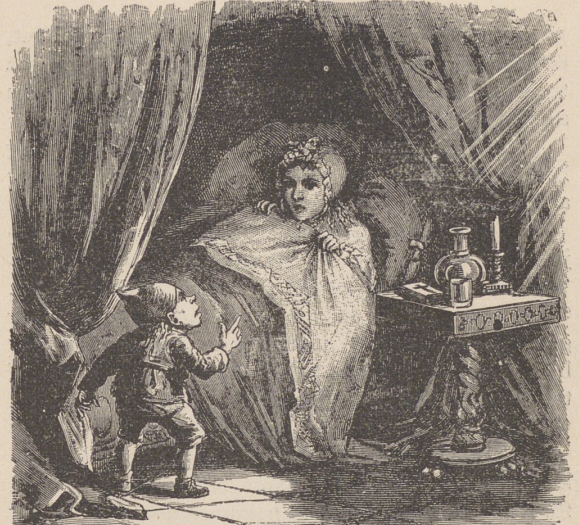
The Lady of Hellerup
Long ago, on the Hellerup estate in Ljungby, there was a family of nobles who had a daughter who was widely known for both her beauty and her brilliant mind.
One night the girl was lying awake in bed, watching the strips of moonlight play on the chamber floor. Suddenly the door opened, and in came a little tomten dressed in a grey shirt and a red hat, tiptoeing silently right up to her bed.
“Don’t be frightened, noble miss!” he said, giving her a friendly look, “I’ve come to ask you for a favor.”
“I’m happy to help, if I can,” answered the young lady, who was beginning to recover from her fright.
“I don’t think it’ll be a problem for you,” said the tomten. “My family and I have lived under the kitchen floor for many years, right under your water barrel. But now the barrel is getting old and has started to leak, so that we’re constantly suffering from a ceiling that drips, what’s more, the maids spill a lot of water, so that it’s never dry in our home.”
“I’ll take care of it in the morning,” the girl promised. The tomten bowed with a flourish and vanished just as quietly as he appeared.
The next day the young lady gave orders for the barrel to be moved, and the tomten’s gratitude was soon apparent: the porridge never burned, no plates or glasses ever broke, and if the maids had early morning chores they always woke up at the right time.
Some time later the tomten once again stood by the lady’s bed in the night. He told her, “I have another request, one that I’m sure you’ll agree to, since you’re so kind.”
“Well, what is it then?” she asked.
“I ask that you honor me and my family by becoming a godparent to my newborn daughter.”
The girl stood up and got dressed, then followed her strange guide through a number of hallways and rooms that she knew have never existed in the house. They stopped in the kitchen, where she found a crowd of little people, including a pastor and godparents, and the little girl was baptised in the normal Christian way.
When the young lady was getting ready to go the tomten asked if he could leave a gift in her apron before she left.
Despite the fact that the gift appeared to be nothing but little splinters and wood shavings, she gratefully accepted and was again conducted through the winding hallways back to her own room.
When the tomten turned to go he said, “If we ever meet again, and I daresay we will, then remember, do not laugh at me or any of my family. We like you because you are gentle and kind, but if you laugh at any of us, then we will never meet again.” And with those words the tomten was gone.
After he had left, the girl tossed the tomten’s gift into the fireplace and went to sleep. The next morning when the maid was going to start a fire she found buried in the ashes of the hearth a piece of jewelry, beautifully made of the finest gold.
Several years later the young lady was to be married, and the wedding was planned to be a magnificent one.
The preparations took weeks. During the day all was quiet under the kitchen floor, while there was a hustle and bustle going on above it, and then at night when it was quiet above, there was a noisy clatter below.
Finally the day of the wedding arrived. The bride in her dress and crown was led into the room with all the guests. During the wedding ceremony she happened to glance at the fireplace in the corner and saw that all the tomtens were there conducting a wedding of their own. The bridegroom was a little tomten, the bride was her little goddaughter, and the whole ceremony was conducted much like the one she herself was in.
None of the wedding guests saw what was happening in the fireplace, but they noticed that the bride would stare at it. Later that evening she turned her eyes back to the fireplace to watch the little wedding party and happened to see a tomten who was serving food trip over a twig of juniper. Forgetful of the advice she had once received she burst out in a hearty laugh. That very instant the vision was gone, and from that moment on no tomten has ever been seen at Hellerup again.
Elestorp Forest
During Queen Margaret’s war with Albrekt of Mecklenburg the two opposing armies once met in southern Halland. The queen’s soldiers had made camp on the soggy grounds of Tjärby, half a mile north of Laholm, while the duke’s men were in the area of Veinge church.
One morning the queen, as was her wont, went to Tjärby church to say her morning prayers, but not before sending out scouts to the so-called Queen Mountain.
While she was praying a messenger came and informed her that several lone riders had been sighted.
“No danger just yet,” said the courageous woman, who continued to kneel before the altar.
After a moment a new messenger came and announced that about a hundred men on horse were coming, but the queen commanded her people to remain still, assuring them that even now there was no danger. Finally a messenger came and said that it looked as if the whole of Elestorps forest was moving against Tjärby.
She then addressed her subjects, “Now, my children, a hard battle awaits us, but God will grant us the victory!” She leaped onto her horse and led her warriors to meet the enemy.
Who had, just like in MacBeth, employed a trick where every soldier held up a leafy branch in front of himself so that they could advance on their enemy unnoticed. But Queen Margaret thwarted them and won a brilliant victory. To show her gratitude to God she had the old Tjärby church completely rebuilt, but ever since, no birch will grow any taller than a man in the forest of Elestorp.
The Little Trolls of Folkared’s Mountain
Few places are gloomier or more desolate than Sibbarps socken in Halland. Most of the land area is taken up by dark, empty heath, and here and there solitary hills of rock rise up out of the brown wastes. Towards the south of the area there is one such stone called Folkared’s Mountain, which has long been rumored to be a haunt of little trolls and the like.
One cold and gloomy autumn day a farmer from Ljungby’s Högared took a shortcut past the “mountain” to Folkared in Sibbarp. As he approached the hill he noticed a little troll, about the size of a seven or eight year old child, sitting on a rock, crying.
“Where do you live?” asked the farmer, who was full of compassion for the little fella.
“Right here!” sniffed the little one, pointing at the mountain.
“But wait, how long have you lived here?” asked the farmer in surprise.
“About six hundred years…”
“For six hundred years! You little liar! I’ll teach you not to tell lies!”
“Ah! Please don’t hit me!” begged the little troll, still crying, “I’ve been beaten enough today already.”
“You’ve been hurt today already? By who?” asked the farmer.
“It was my dad. He punished me.”
“I see. And what did you do to deserve it?”
“Well, I was checking in on great grandpa, but when I turned to go he fell and hurt himself on the floor.”
Then the farmer finally understood what sort of creature he was dealing with so he reached for his knife, to have something of steel to defend himself with. But just then there was an awful din in the mountain and the little troll vanished.
The Snapphane’s Grave
During King Karl the Eleventh's bloody war with Denmark a group of snapphanar moved out of Skåne into Halland, and as usual left a trail of plundering and death behind them. After all the farms of Hishult were plundered some of them went back to Skåne, while the rest continued marching north.
A group of commoners had gathered in Böghult to try and stop their advance. Most of them had no other weapons but axes, scythes, and clubs. There were just two men who were better armed; brothers, each with a musket. As woodsmen and hunters they were skilled with their weapons, and when the defensive forces were put into place the two shooters were posted farthest out along the road. It was there the snapphanar forces were thought to march in, and the rest of the men gathered some distance behind.
After several hours of waiting a ragged man came riding up the road on an unruly, scruffy little horse without a saddle. In the distance the two hunters could hear the sounds of the approaching troop; laughter and drunken singing.
“Do it! They’re coming!” said one of the brothers.
“Don’t you see? That there is dad’s horse, they must have stolen it,” answered the other, as he raised his weapon to his shoulder.
“Wait!” Whispered the first man, “mine shoots straighter than yours, let me drop the thief!”
He pulled the trigger and the forest rang with the sound of the shot. The rider tumbled from the horse.
Horrified over their own deed, the two brothers ran back to the rearguard. But there was no more sign of the enemy. The next day some of the bolder farmers went out to reconnoiter, but they found neither hide nor hair of the snapphanar. They did, on the other hand, find a stone cairn that the snapphanar had raised over their fallen commander, which has ever since been known as the snapphane-grave.