
Swedish Folktales: Småland
From "Svenska folksägner" by Herman Hofberg.
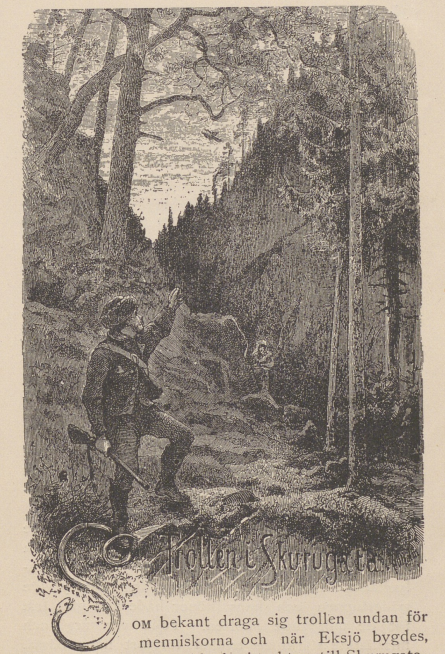
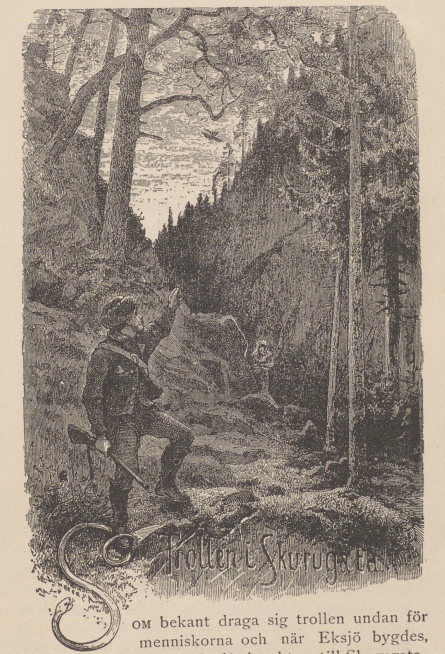
The Trolls of Skurugata
As everybody knows, the trolls have retreated as humankind advanced, and when Eksjö was built, all the trolls that lived in the area fled to Skurugata.
Here it seemed they would be able to enjoy the peace and quiet, for the place was lonely and bleak. Two great mountains rose straight up so close to each other that the little sunlight that does manage to make it down to the bottom of the “street,” as the narrow lane is called, is but a twilight. But the bold grenadiers of Småland have not left the trolls in peace even there, for I have heard that when the army met on Ränneslätt the entire battalion would march through the street with drums and trumpets several times, indeed, they would even fire their rifles down there, which shook the very hearts of the trolls living in the mountains. Thus, I doubt the trolls enjoyed well-being, even in Skurugata.
In the vicinity of that cracked mountain there was a spring that was considered holy, and in the days of old people who lived in the area would make offerings there to the spirits of that place. I don’t know whether or not people still do. Enlightenment is on the rise, they say, and all those peculiar old traditions will soon belong only to the past. A few decades ago this wasn’t the case: then you could, at least according to old folks, still have the pleasure of both seeing and talking with the trolls, not to mention the kyrkogrimmen, gloson, and many other respectable greats of the spirit world.
Once upon a time there was a hunter named Pelle Katt, who one day went to Skurugata to hunt grouse, because it was mating season for the birds. The hunt was an utter failure. The magnificent male and all his hens escaped Pelle Katt’s murderous shots. Pelle was angry and strongly suspected that the trolls had bewitched his shotgun. He swore and cursed all the trolls of the world and especially those that lived in Skurugata. Just as he passed by the mouth of the crevice, a woman walked out, small and with a curious appearance, and she was carrying a little poodle in her arms.
“I’m to bring greetings from the Lady; she wants you to shoot this here dog.”
“Tie the cur to a tree so it doesn’t run off before the deed is done,” answered Pelle.
So the dog was bound to a tree, and the little woman vanished into Skurugata between the two walls of stone. Pelle then took his shotgun and sent a cloud of pellets into the dog’s head. But what was it he saw, when the smoke cleared? It was his own little child lying there, wrapped in the skin of a dog.
Now, Pelle Katt did not have the best reputation. He was quarrelsome and hard-hearted; a sullen, gloomy man of few words. But he was also a boozer, and when drunk he would loudly boast that he was afraid of neither God nor the devil himself.
But now, for the first time in his life, he was in shock, distraught and helpless.
“My God! What have I done!”
He shook so violently his knees knocked together, while sweat ran from every pore.
The troll woman came back out from the mountain and said, “Here you are Pelle Katt, take your payment!” She threw a heavy coin at Pelle, and it fell right into his open hand stuck there, as if glued. Then she picked up the slain child and carried it back into the mountain.
Pelle hurled the coin at the departing figure and cried out, “no! I won’t take your dirty money for such an act. Take it back, you vile troll!”
A hoarse laughter from out the mountain was his only answer.
Pelle went home. His child was gone. His wife wept, but Pelle said nothing, and left for the tavern. He had no money with which to buy the liquor he needed to drown his sorrow, but out of long habit he stuck his fingers down into his vest-pocket in hope of finding some forgotten copper-piece. And behold! there it was, the same coin that he had just thrown back at the troll woman. Now, he let it fall onto the bartop, and bought enough liquor to forget: he forgot his child, his wife, himself, heaven and hell, everything.
When he sobered up, he found that same coin back in his pocket. Certainly he tried to throw it away a few times, but since it always showed back up in his pocket again he used it time and time again to buy himself forgetfulness, until finally one time he slept and never woke up again.
So goes the story of Pelle Katt and the trolls of Skurugata.
Kettil Runske
Long ago there lived two mighty kings on the island of Visingsö, one lived at Näsbo and the other in Borga castle. Once during a border dispute the King in Näsbo sent a messenger to ask Gilbertil the wizard, from Östergötland, to dig a great tunnel all the way across the island, ultimately dividing it into two separate parts. Gilbertil took the project on and began digging near Näs, where even to this day a deep hole leads down into the earth. But when news of this endeavor reached the ears of the king in Borga, he too sent a messenger to a wizard of renown, Kettil Rundske in Västergötland. Kettil returned to Borga with the messenger, though the crew manning the boat couldn’t see him. Still, they knew he was there because a giant-like weight pressed the boat down so that the gunwales were right at the water’s surface. When they drew near Borga castle the boat suddenly bobbed up, and the crew knew that Kettil was no longer on board.
Gilbertil had just finished his work north of Kumlaby, about halfway across the island, when Kettil came and caused the earth over him to open up, and Kettil commanded Gilbertil, “cease this digging!” But stop he did not, instead he responded with scorn and mockery, provoking Kettil to throw his magic staff at him, which was carved with many runes. Gilbertil was able to catch the staff in the air, but his hands stuck to it, and he couldn’t get them free. He tried to break the staff with his feet, but then they too were stuck. In frenzied rage he tried to free his hands by pulling at the staff with his teeth, but then his mouth was stuck to the staff as well. Thus with hands, feet, and mouth bound to the staff, Kettil threw him down into the deep hole, which can still be seen in the meadow by Kumlaby, and has since borne the name of Gilbertil’s Hole.
The Lady of Soåsa
Soåsen, a mountain ridge not far from the city of Eksjö, was long ago the home of an important troll-woman generally called the Lady of Soåsa.
The Lady and her ancestors before her had lived in that ridge since ancient times, but near Eksjö is Ränneslätt, a training field for Sweden’s army. Once soldiers began shooting there (or “crack nuts” as the trolls themselves said), the Lady of Soåsa could find no peace in her ancient home, and she fled to her sister, another powerful troll-woman, who lived in Skurugata, the very same mountain in the story of Pelle-Katt.
The Lady of Soåsa was very skilled in magic, very rich, and very cranky. It was best not to give her any cause for offense, because if you did it would be punished immediately.
Gravendal of Flisby, a cavalry soldier serving in Småland’s dragoons, was standing guard one morning on a remote part of the training area, when he caught sight of a very little old lady, a “crone,” wandering along the edge of the woods. In his arrogance Gravendal sent the old hag away with hard words, but the same moment he spoke he took a blow on his ear that sent him up into a tall pine tree, where he stayed until he could get some assistance from his comrades.
On the other hand, people who were decent to the Lady earned a sort of good-will from her. One poor old woman, a real human, not a crone or a troll, lived in a little hut nearby Soåsa. Once she was in great need: she was out of bread and had no neighbors, and already famine was a guest in her house, sitting at her table looking at her, grim and threatening.
Late one evening she heard a pounding on the door.
“For God’s sake, just come in!” she cried, feeling unusually peevish.
“I’m not going to enter in that name, but I do bring work for you from the Lady of Soåsa. Spin good thread with this linen here, but don’t use spit to wet it, because then the thread would be Christian, and the Lady doesn’t tolerate that.”
“Where should I drop off the thread?” asked the old woman, trembling.
“Go straight into the forest, and will find a green and level clearing. Leave the thread there and the next day you shall get your payment.”
The old woman found linen fiber right outside her door, and she began to spin right away. She placed a bowl of water next to her, which she used to wet the thread.
Soon she had finished the skein and she walked straight out her door and into the woods. Just as the troll’s maidservant had said, she came to a lovely grassgrown clearing, surrounded with tall leafy trees. She laid her thread upon the grass and hurried home without looking back. The next day she returned to the same clearing to find a new bundle of fiber and a few silver coins.
A golden age dawned for the poor old woman. With her new job she collected money and grew rich, but she grew greedy too. She forgot her prayers, which she had never before neglected when she laid down to sleep.
Finally she didn’t even bother to keep her word with the troll, and one day she spun linen the common way, wetting the thread with her spit. Finished with the work, she laid the skein down in the usual place, but when she went back the next day to collect her money, she couldn’t find the clearing, and on top of that got lost out in the woods. She didn’t find her way back until a whole day had passed, and when finally home she rushed to count her money, only to find that all of her fine silver coins had turned to pebbles.
She found herself in dire straits once more, this time much worse, because no one wanted to help a woman who had done business with the infamous Lady of Soåsa, and the old woman died in misery shortly thereafter.
Long ago there was a councilman in Eksjö by the name of Lind, and he had a farm girl who worked for him. It was her task, to at day’s end, go and find the councilman’s cows which wandered and grazed in the woods that surrounded Soåsen. The poor beasts were not thriving on the forage, and sometimes it happened that the girl couldn’t even find them, even though she looked long and well. And then, once the animals were finally found, they were already completely milked out. One evening the girl was heading through the dim forest back to the farm, brooding and gloomy, thinking about the scolding she was going to get when she returned with neither milk nor cows. Maybe she was frightened too, remembering all the stories about trolls and ghosts that haunted that very same wood.
Then she caught sight of two small creatures that looked like children: a boy and a girl. They were sitting under the branches of a tall spruce tree.
“I had better be polite,” thought the girl, “since I’m on the trolls’ own land!” And so she addressed the two small troll children kindly and offered each one one of her own sandwiches. The troll-children ate greedily and it was unpleasant to watch them: they had wide mouths into which the sandwiches quickly vanished.
When the girl continued on her way, she heard a voice say, “Since you have shown my children compassion, you will never again have to search for your cows. Go home! They are waiting for you by the gate.”
After that day the girl never had to look for the councilman’s cows, which have since provided an abundance of good milk, and come to the gate every evening on their own, and wait to be milked.
Puhke the Giant
There is a mountain by the sea in Lofta socken, called Puke Mountain. On the side that faces away from the water there is a long crack that leads to a chamber or hall, where there once lived a giant, Puke, about whom many stories are told.
After a church was built in Lofta, this giant suffered greatly, due to the ringing of the bell. He also suffered from the moisture in the stone, which seeped and dripped out from the mountain. It got so bad that a pond, Kofre springs, formed in the meadow just north of the church, big enough that they sometimes used it for baptisms.
Puke would often say that he needed to move away from his mountain because of
Kofre springs
And Lofta rings,
Referring to the pond and the churchbell.
One Sunday the ringing of the bell was bothering Puke worse than usual, so he sent his daughter up to the top of the mountain, where she used her apron as a sling to cast a huge boulder at the belltower. But she was too strong and threw too hard, and the stone sailed over the church and fell harmlessly to the ground, and lies there to this day, as big as a small house!
One day this giant maiden was walking about, and she noticed three children on a hill. They had found an oak branch and tied a heavy rope to it, and were pretending that it was a plough: one of the children worked the plough, and the other two pulled. Intrigued by the curious equipment and the tiny little draft animals, she took and put them in her apron and brought them home to show Puke, her father. But he wasn’t pleased with her new toys, he said, “Take them out again: our time is over. It’s now going to be such as these that shall rule over the likes of us.”
Finally Puke had had enough of it all and moved to Gotland, where he met a skipper from Lofta. He gave the seaman a box and asked him to put it on the altar of the church there in Lofta while the congregation was gathered, but he strictly forbade the sailor from opening it.
“If you do as I say,” said the giant, “then you will find in the church’s foundation a stone, under which is a key, which you then can use to enter Puke Mountain. When you do, you will see a door that you should open, and when you enter there will be two black dogs, but you needn’t be afraid of them. Just walk past them into the room and you’ll find a table covered with cups and pitchers of fine silver. You may take the largest silver pitcher, but you’ll regret it if you take anything more than that.”
The skipper remembered Puke’s words, and when the ship approached Puke Mountain the crew began asking about the box. After much deliberation they decided to throw the skipper overboard near a small island that happened to be near at hand. But when they did so, the island burst into flame, leaving it a barren and deserted rock, which it is to this very day
The Mansion of Katrineholm
Have you, dear reader, ever seen a waterfall by the name of “Stalpet?” If not, then I can tell you that it can be found in the picturesque, and if you listen to the tales, perhaps even romantic, landskap of Småland. There the Black River, after calmly flowing through green meadows in hundreds of gentle curves, cascades down a nearly vertical face of rock, to then rest in a lake that lies below.
Not far from Stalpet Falls there is an old mansion, gloomy, dark, and abandoned. Just to gaze upon the great building with its boarded up doors and windows makes you dispirited and glum, and you begin to suspect that there must be a reason behind the brooding silence. Why should such a scenic place be abandoned? Why isn’t there at least a caretaker or a tour guide in that old, spacious building?
Let us now listen to the words of a kindly old woman, who once explained to me why the mansion is the way it is. I’ll use her own words, of which, perhaps there may be a surplus, but for just that reason they help to give her tale its authentic local character. To understand what the woman has to say about the mansion, we need to hear her tale from the beginning, and truly I mean the beginning, for her story begins with the dawn of time. So, I asked her, “Why isn’t there any gentry living in Katrineholm?” and this is the answer she gave:
Well, first you should know that when Satan was cast out from heaven because of his pride and arrogance, there were other spirits with him, spirits that he had tempted into joining him in his rebellion against God. These beings were also cast out from heaven, and like yellowed leaves in an autumn storm they fell to the earth; some fell into lakes, others into forests, and others fell onto mountains. Wherever they fell, there they remained, and it was from that place that each one acquired their own profession, so to speak. They also took their names from where they fell, thus we have sjösrå, bergsrå, skogsrå, and elves, and witches…they’re all described in the old catechism.
Now it just so happened that on that day when all the rebellious spirits were cast out of heaven, two fell onto the rock where Katrineholm mansion now stands and became mountain folk. And after them, their offspring have lived there ever since. Many hundreds, even thousands of years they lived there, and though it happened that now and then one of them would be struck down by lightning, they were otherwise left in peace, and in turn they gave no offense to anybody else either.
But long ago there was a nobleman, who owned the Katrineholm estate, and he was going to build himself a house.
As a wise man, he looked for solid ground to build his home upon, and he decided on the very same island of rock that the trolls lived in.
The Mountain King - as his people called him - was not at all pleased, but his wife, who was good-natured for her race, asked her husband to be calm, and not do anything until after they had tested the humans’ character.
When the house was finished the nobleman wedded a beautiful young lady, and they filled their new home with joy.
But lurking sorrow waits for many people who are unsuspecting, and so was the case here.
One day when the young bride was alone in her workroom, a little woman appeared in front of her, she curtsied and said, “My mistress wishes that you pay her a visit, and I’m to say that if you do so, you will be richly rewarded.”
The young lady was somewhat taken aback by the request, but her heart was brave and her conscience clean, so she agreed to go and followed after the messenger.
The little woman led the way down several stairways until they came to the cellars, and there they found a door the human residents of Katrineholm had never seen before, and it was built right into the solid rock of the island. Both women went through the doorway and into a long, dark tunnel that led to a large vault, with walls that sparkled of silver and gold. In this magnificent chamber a small man was pacing to and fro, he seemed troubled, maybe even scared. He didn’t speak to the young lady, but he looked at her pleadingly with eyes that seemed both humble and searching.
The little woman pushed aside a curtain to yet another vault, and now the young lady saw another troll-woman. She lay upon a tidy bed, but was sick, and suffering through a difficult childbirth. But the presence of the Christian woman was so powerful that the Mountain King’s wife gave birth, and felt better right away. The Mountain Queen then produced a little chest, filled with pearls, gemstones and jewelry, saying, “Take this in memory of me, but don’t let anyone know what has happened here, because if you do, you shall suffer great misfortune.” The lady returned up the stairs to her room and there she carefully hid the box of queenly treasure.
Time passed, and everything seemed to go well in the new house, and the young lady became herself the mother of two growing young boys.
One day when the brothers were playing alone, one of them found the little treasure chest and they had just begun to play with its contents when their father walked in. He was shocked to find such treasures in the hands of his children, so he turned and left to go find his wife and ask her where she had got them. At first she refused to tell her secret, but that only made her husband more curious. Eventually he grew angry, he even accused her of being a witch, he said he thought he himself had once seen her come flying through the air on a broomstick. This was just too much for the poor misunderstood woman, so she told him the story of her visit to the trolls, but added, “But now our best days are behind us. Because of your curiosity we are going to experience misfortune the likes of which you can’t imagine.”
Just a few days later in the lake below the waterfall, an island appeared, which, oddly enough it seems to do when some strange and important event is about to occur. The island is supposed to have been seen right before the deaths of kings Karl XII and Gustav III, and people say that one of the kings had his name carved into a rock on the island, and that somebody has seen that stone, when the island appeared later.
I don’t know why the island showed up that time, maybe the trolls in the stone were in league with the sjösrå, or maybe for some other reason, but either way, the mysterious island was plain to see and the curious nobleman was eager to get a closer look at it.
He wanted his wife and their two sons to come along too. The lady, fearing that misfortune was now at hand, protested and argued against the idea with all her might, and when that failed she fell to her knees and pleaded and begged, but in vain.
Finally, the stubborn man took the boys and left his wife at home, and the three of them rowed out to the island. Just as the boat bumped into the enchanted isle the two boys hopped out onto the rocky shore, but just then the island disappeared and the boys with it, and their father never saw them again.
The poor woman died of grief, mourning her lost sons, and her husband then left, traveling to some foreign country, where he too passed away. But the building on Katrineholm has been empty ever since, and it’s hard to imagine that anyone living there could be happy, at least for long.
Ebbe Skammelsson
On a narrow point that reaches down into Lake Bolmen from the north, there lies an old manor called Tiraholm, usually called just Tira.
Long,long ago there was a knight who lived there with his wife and their only child, the beautiful girl Malfrid. She was the most lovely maiden in the entire kingdom, and rumor of her beauty spread far and wide, luring many suitors to Tiraholm. But Malfrid was indifferent and cold, and she dismissed them all, one after the other.
One day a rider, splendid and gallant, rode up to the manor. His name was Ebbe Skammelsson and he had recently returned from foreign lands, where he had earned his golden spurs and been dubbed a full-fledged knight.
With furtive, downcast eyes and cheeks blushing red Maiden Malfrid offered her hand to the stranger in greeting, who courteously took it, and greeted the lady in a most chivalrous manner.
The knight stayed as a guest at Tiroholm, and soon it was announced that Ebbe and the fair Malfrid would be wed, dashing the hopes of many a young bachelor. But as the betrothed were both still quite young, the knight intended to first join a crusade to the Holy Land and thereby win even greater glory. So it was decided that the wedding would wait, and celebrated first after Ebbe Skammelsson returned in triumph.
Some time after Ebbe rode away the old knight, Malfrid’s father, died, and his daughter was left alone with her mother in Tiraholm. Year after year passed without a word from Ebbe. The roses on Malfrid’s cheeks faded and her dark eyes lost their sparkle. Her mother was deeply saddened by Malfrid’s sorrow and longing, and so she made arrangements for Malfrid to marry another.
In the belief that the knight Ebbe Skammelsson had fallen to the swords of unbelievers she prepared now a festive wedding, and the newly engaged were made man and wife through the sacrament of holy matrimony.
But just as the wedding party took their seats, a knight all in gold galloped into the yard. The bride went pale under her tiara, but her mother, who saw that this man was Ebbe, hurried forward to exchange words and remind him that seven years had passed, and that his betrothed was now the bride of another man.
In wrath he turned his horse, drew his sword, and after rebuking the faithlessness of the woman who was once to be his mother in law, he beheaded her with a single stroke. With his sword dripping blood he jumped out of the saddle and into the wedding hall, where the bride fell to his blade, and after another swift stroke the bridegroom joined her in death.
Suddenly struck with remorse the murderer leaped onto his horse and rode away into the pathless wood. But his conscience gave him no peace. Night and day he saw the shades of his victims, and there was nowhere he could go where they would not follow. He finally resolved to journey to Rome, and there at the feet of the Holy Father confess his sins and beg for forgiveness. And for a large sum of money he did in fact receive a letter of indulgence from the Pope, but the forgiveness of men was not able to still the anguish of his soul nor quiet the storm in his heart. He returned to the homeland of his betrothed and begged the judge to sentence him with the hardest doom under the law.
After much discussion the assembled court decided that he, Ebbe Skammelsson, would be fettered with 130 pounds of iron, and would thus encumbered spend one day on each and every of Bolmen’s sixtyfive islets. The sentence was put into effect at once. To move himself, he had a small boat, and on that boat he dragged himself, like a wounded bird, from one islet to the other.
When the punishment was complete, he came ashore at Angelstad in Sunnerbo. Here he staggered into the village and cast himself down in a barn to sleep. Meanwhile, the sad fate of Ebbe Skammelsson had made a deep impression on the people. A folksinger had written a song about his misfortune, and a fortune-teller had foretold that when he heard that song for himself, his chains would fall off and he would die. And that morning while he lay hidden in the barn, a maid walked in to milk the cows, singing “The Lay of Ebbe Skammelson.” Ebbe listened intently, and when the final verse was sung, he shouted, “Some of it’s true and some of it isn’t!”
Frightened out of her mind the maid jumped up and ran back to the house, telling the people inside what had just happened. Quickly the villagers gathered around the barn where Ebbe lay, and asked him to tell them where he came from and who he was. Still fettered with 130 pounds of iron, he dragged himself out onto the grass and told them his name, then asked to be taken to the cemetery.
Between the village and the church in Angelstad’s there is a huge rock, and when the group reached the place where it lies, Ebbe climbed onto it, raised his eyes to heaven and cried, “If I am worthy to rest in the church’s holy ground, then please, let it be so…”
The fetters fell from Ebbe’s hands and feet and he sank to the earth, dead.
The villagers who were with him took his body and brought it to the cemetery, where they buried him under the walkway, but outside the cemetery itself so that everyone who went into the graveyard would tread upon his grave. The following night there was a sign or omen, because a long stretch of the cemetery wall collapsed right in front of the new grave. The farmers quickly set it in order again, but again the following night it fell once more. Then it was clear to everyone that the wall collapsing was a sign from heaven, and the outlaw should be allowed to rest in the church’s cemetery. So the local officials added land to the graveyard and moved the wall so that Ebbe lay within its bounds, and to this day there stands a stone to mark his final resting place.
The fetters, which they say hung in Angelstad’s church for a long time, were forged into three iron crosses that were put up on the current church’s roof, and which look like those crosses they set up in the old days in memory of the dead.
The Missing Farmhand
There once was a man in Ingeltorp who had a farmhand named Johan. Among many other chores, he would provide transportation for visitors to the Myntorp Inn.
One day word reached him from the inn that there were customers who needed a ride. So Johan threw a halter over his shoulder and walked out into the horse paddock, whistling the latest popular lovesong. But that day the horse, Brunte, stubbornly refused to be caught. He didn’t bolt, he could still be seen peering out from behind a bush or the like, but as soon as Johan got too close Brunte would startle and run away. Johan ran about and sweat beaded on his forehead, but it was all for naught. Finally in pure frustration he started to curse and swear in the most un-Christian sort of way. When he looked up from the ground he had just cursed he saw a great boulder with sheer sides, and when his gaze wandered all the way to its top he saw there a beautiful young maiden, who sat combing her hair.
“Is that you, my boy?” she cried happily.
Johan was not so easy to frighten, so he replied just as cheerily, “Yes indeed, my dear!”
“Then come here!” said the maiden.
“But I can’t climb this!”
“Just give it a try!”
And Johan tried. To his amazement his feet found purchase on the smooth stone, which to his eyes were still smooth and impossible to scale, and soon he found himself on the top of the boulder with the girl. She gazed upon him with eyes that were wide and rather strange. Johan felt a sort of haze settle over his mind, and he forgot the horse, his home, his family and his friends. Only half aware he was led into the stone, but for those who searched for him, he was simply gone.
After that Brunte allowed himself to be harnessed and gave plenty of rides to travelers, but the farmer had to do the driving himself, because as his sons were growing up and getting big enough to work, he didn’t want to pay for another farmhand.
Many years after Johan disappeared the farmer went into the paddock after his horse, again to provide a lift to a traveler. He thought about his long gone farmhand, and wondered what could have happened to him.
“It’s just too bad about the boy,” he said to himself. “Gosh, I wonder if he was bergtagen?”
He turned his gaze from the ground and saw before him the immense boulder where Johan had once seen the troll-maid, and what did he see there? Johan in the flesh, standing there with glassy eyes and staring out into space.
“Johan, my boy, is that you?” he shouted. “Come down!”
“I can’t,” answered Johan, dull and listless.
Then the farmer threw his cap to Johan, which he then put on his head.
“Come down, come down!” cried the farmer, “before the trolls come back. In the name of God, hurry up!”
“But I can’t,” said Johan again.
Then the farmer threw all his clothes at Johan, one garment after the other, and when Johan was fully dressed in them, he had enough control to slowly clamber down the rockface. The farmer grabbed his hand, and without looking back he hurried home, while he chanted:
Begone, foul trolls,
Your tongues I here bind,
And no harm shall you think,
And no lies shall you speak,
Nor say a single word against me.
And so they made it back to the farm, one dressed and the other not. The traveler was forgotten, and enraged had to find himself another lift, because everyone on the farm was so happy to have Johan back that no one thought about anything else. But Johan, he never really recovered, he was changed forever, becoming sad and gloomy.
The farmer asked him several times what it was like to serve the trolls in the boulder, but Johan didn’t want to talk about it and answered evasively. But one day when he fell ill and asked for one last communion and confession, he finally told what it was like for him in the mountain. He said mostly he was tasked with stealing for the trolls. They would put a red hood on his head, and with it he could fly all the way to Jönköping and through locked doors and into the stores of merchants, and there he took grain, fish, salt, whatever he wanted. When he wore the red hood he was so strong that he could carry a barrel of rye under each arm, and a barrel of salted herring on his back, and still fly just as fast as when he carried nothing at all.
“It was wrong of me, and it was hard for the shopkeepers,” Johan said, “but it was the trolls’ fault. If there were no trolls in the world, then every shopkeeper would be a rich man, but now they can’t even make ends meet, and go bankrupt.” And so passed Johan the farmhand.
The Lost Treasure
Hundreds of years ago when the enemy had invaded Småland, the people of Stenbrohult collected their money and other valuables and put them in a big copper kettle, which they hid by lowering it down into Lake Möckeln. It lies there still, and will probably stay there forever, though not for a lack of people trying. Many treasure hunters have felt it when they prodded with a pole or dragged a net. But every time it’s been disturbed it has moved itself farther out, so that now it lies near the outlet of the lake, where it is so deep that no one can get to it.
When the rest of the people of Stenbrohult hid their valuables in the lake, there was one wealthy farmer who instead buried two small casks of silver near Kalfhagsberget. Shortly thereafter he died, leaving his money where he had hidden it. Around that time two strange lights began to be seen in the evening over the place where the treasure lay hidden, a sure sign that a spirit or dragon had claimed it for its own.
There was a poor old man who heard about the lights, and he knew that a man could take riches like that for himself if he digs them up on a Thursday evening and carries them home in perfect silence, and without looking back. Thus he figured the silver was as good as his.
He set out to claim the treasure and managed to pull the casks out of the ground. But when he was on his way home, he bumped into his neighbors, one after the other, and they all asked him where he had been.
The man understood what was going on…these people weren’t actually his neighbors, each one was the spirit that had claimed the treasure, just taking the shape of people he knew, so he kept his mouth shut. But finally he ran into the pastor, who stopped walking and greeted him, saying, “Good evening!” he said. The old man didn’t dare to ignore the pastor, so he lifted his cap and returned the courtesy, “Good evening!” he said.
With the next step he took he tripped over a tree root and dropped his casks, and when he went to pick them up again all he saw were two old birch bark baskets, and he had to return home empty handed.